
How AI is Transforming RTL Design and Verification in VLSI Frontend Engineering (2026 Guide)

Introduction
The semiconductor industry is experiencing one of the biggest transformations in its history. With the rapid growth of Artificial Intelligence (AI), modern chip design is becoming more complex than ever before. From AI accelerators and high-performance processors to edge computing devices, today’s chips require billions of transistors and sophisticated design methodologies.
Traditionally, RTL design and verification have relied heavily on manual engineering effort. However, AI-powered Electronic Design Automation (EDA) tools are now helping engineers automate repetitive tasks, improve productivity, and reduce time-to-market.
This article explores how AI is changing RTL design and verification, what skills frontend engineers should develop, and what the future looks like for VLSI professionals.
What is RTL Design?
Register Transfer Level (RTL) design is the process of describing digital hardware behavior using Hardware Description Languages (HDLs) such as:
- Verilog
- System Verilog
- VHDL
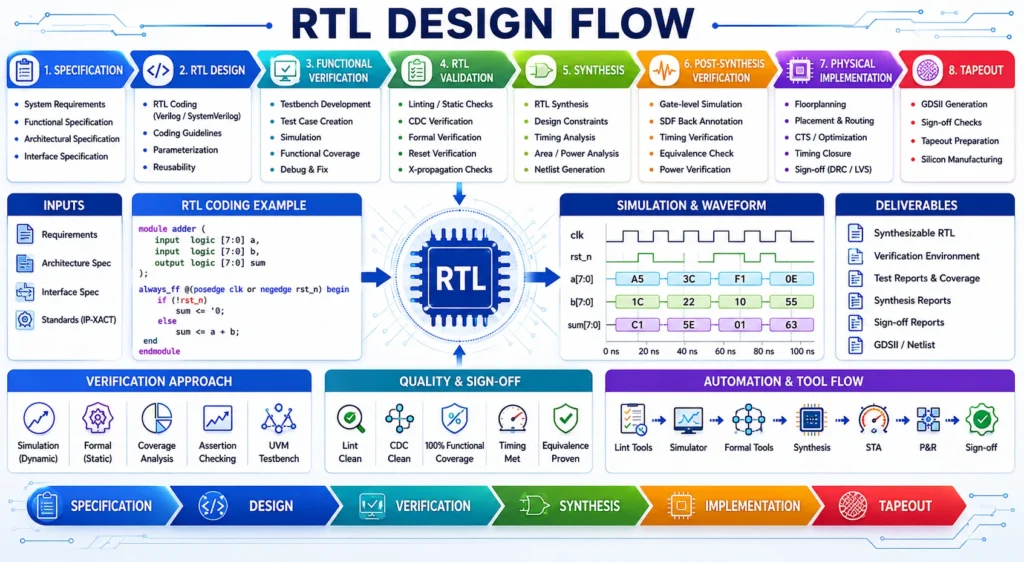
RTL acts as the bridge between system architecture and gate-level implementation.
Frontend engineers use RTL to:
- Develop communication interfaces
- Create memory controllers
- Design processors
- Build custom ASIC and SoC components
A well-written RTL design directly impacts Power, Performance, and Area (PPA).
Why AI is Entering the VLSI Frontend Flow
Modern chip designs contain:
- Billions of transistors
- Thousands of verification scenarios
- Complex timing requirements
- Multiple power domains
As design complexity increases, traditional manual workflows become difficult to scale.
AI helps by:
- Generating RTL code
- Identifying design bugs
- Automating verification tasks
- Predicting timing issues
- Improving design space exploration
This significantly reduces engineering effort while increasing productivity.
AI Applications in RTL Design
1. RTL Code Generation
AI-powered tools can generate Verilog or System Verilog code from natural language descriptions.
Example:
Input:
“Design a 16-bit synchronous up counter with asynchronous reset.”
AI can generate:
- Module declaration
- Counter logic
- Reset logic
- Testbench skeleton
This accelerates development and reduces coding effort.
Benefits
- Faster development
- Reduced boilerplate coding
- Improved productivity
- Better documentation
2. Microarchitecture Assistance
AI tools can assist engineers in:
- Pipeline planning
- Resource allocation
- Interface generation
- Architecture tradeoff analysis
Instead of replacing engineers, AI acts as an intelligent design assistant.
3. RTL Bug Detection
AI models can analyze RTL code and identify:
- Latch inference issues
- Unreachable states
- Coding violations
- Potential timing bottlenecks
Finding bugs earlier reduces expensive redesign cycles later.
AI Applications in Verification
Verification often consumes nearly 70% of the overall chip design effort. This makes it one of the biggest opportunities for AI-driven automation.
1. Automated Testbench Generation
AI can generate:
- UVM environments
- Sequences
- Scoreboards
- Coverage models
This reduces manual effort and speeds up project execution.
2. Intelligent Coverage Analysis
Coverage closure is one of the most time-consuming verification activities.
AI helps identify:
- Coverage holes
- Redundant tests
- Missing scenarios
This allows teams to focus on high-value test cases.
3. Automated Debugging
Debugging simulation failures can take hours or days.
AI tools can:
- Analyze waveforms
- Trace root causes
- Suggest fixes
- Highlight suspicious signals
This dramatically reduces debug time.
Will AI Replace RTL Engineers?
The short answer is No.
AI can automate repetitive tasks, but it cannot fully replace:
- Architecture decisions
- Protocol understanding
- System-level thinking
- Silicon debugging
- Performance optimization
Successful frontend engineers will use AI as a productivity tool rather than viewing it as competition.
The future belongs to engineers who can combine:
- RTL expertise
- Verification skills
- AI-assisted workflows
- System architecture knowledge
Skills Every Frontend Engineer Should Learn in 2026
To remain competitive, engineers should focus on:
RTL Design
- Verilog
- SystemVerilog
- FSM Design
- Low-Power Design
Verification
- UVM
- Assertions
- Functional Coverage
- Formal Verification
Design Concepts
- Clock Domain Crossing (CDC)
- Reset Domain Crossing (RDC)
- Timing Analysis
- Power Optimization
AI Awareness
- Prompt Engineering for EDA
- AI-Assisted Verification
- AI-Based RTL Analysis
- Intelligent Debug Tools
Career Opportunities
The growing semiconductor industry continues to create opportunities in:
- RTL Design Engineering
- Design Verification
- FPGA Design
- SoC Design
- AI Hardware Development
- EDA Tool Development
Professionals who understand both VLSI and AI will have a strong advantage in the coming years.
Challenges of AI in VLSI Design
Despite its benefits, AI still faces several limitations:
- Hallucinated RTL code
- Incomplete verification logic
- Security concerns
- Limited understanding of complex architectures
Human review remains essential before tape-out.
Future of VLSI Frontend Engineering
The next generation of chip design will likely involve:
- AI-assisted RTL development
- Automated verification environments
- Intelligent design optimization
- Agent-based EDA workflows
- Faster design cycles
Rather than replacing engineers, AI will allow them to focus on higher-value engineering decisions.
Conclusion
Artificial Intelligence is rapidly transforming RTL design and verification workflows. Engineers who embrace AI tools can improve productivity, accelerate development cycles, and deliver better chip designs.
However, fundamental VLSI knowledge remains irreplaceable. Strong expertise in RTL design, verification methodologies, timing analysis, and system architecture will continue to be the foundation of a successful frontend engineering career.
The future of VLSI belongs not to AI alone, but to engineers who know how to leverage AI effectively.
Frequently Asked Questions (FAQ)
1. What is RTL design in VLSI?
RTL (Register Transfer Level) design is the process of describing digital circuit behavior using hardware description languages such as Verilog and System Verilog. It serves as the foundation for ASIC and FPGA development.
2. How is AI helping RTL designers?
AI assists RTL designers by generating code templates, detecting design issues, improving documentation, and automating repetitive design tasks. This allows engineers to focus more on architecture and optimization.
3. Can AI generate Verilog or System Verilog code?
Yes. Modern AI-powered tools can generate Verilog and System Verilog modules from natural language prompts. However, engineers must review and verify the generated code before implementation.
4. Will AI replace VLSI Frontend Engineers?
No. AI can automate routine tasks, but it cannot replace engineering judgment, architecture planning, protocol understanding, timing optimization, and silicon debugging. Engineers who use AI effectively will be more productive and valuable.
5. Which skills are most important for VLSI Frontend Engineers in 2026?
The most in-demand skills include:
- Verilog
- SystemVerilog
- UVM Verification
- Assertions (SVA)
- Functional Coverage
- CDC/RDC Analysis
- Low-Power Design
- AI-Assisted EDA Workflows
6. Is verification still important with AI tools available?
Absolutely. Verification remains the largest part of the chip design cycle. AI helps automate test generation and debugging, but engineers are still responsible for ensuring complete functional correctness.
7. What are the best career opportunities in VLSI Frontend Design?
Popular career roles include:
- RTL Design Engineer
- Design Verification Engineer
- FPGA Engineer
- SoC Design Engineer
- Formal Verification Engineer
- AI Hardware Engineer
- EDA Tool Development Engineer
8. What is the future of AI in semiconductor design?
The future includes AI-assisted RTL generation, intelligent verification, automated debugging, design-space exploration, and agent-based EDA workflows that can significantly reduce chip development time.
Key Takeaways
- AI is transforming RTL design and verification workflows.
- Frontend engineers can use AI to improve productivity.
- Verification remains critical despite automation advances.
- System Verilog and UVM continue to be essential skills.
- Engineers who combine AI knowledge with VLSI expertise will have stronger career opportunities in the semiconductor industry.