SystemVerilog vs Verilog: What’s the Difference? Which One Should You Learn First in 2026? Smart guide
SystemVerilog vs Verilog: What’s the Difference? Which One Should You Learn First in 2026?
If you’re planning to build a career in VLSI Frontend Design, you’ve probably come across two popular hardware description languages—Verilog and System Verilog.
Many beginners ask:
- Should I learn Verilog first?
- Is SystemVerilog replacing Verilog?
- Which language is used in RTL Design?
- Which one is better for Design Verification?
- Which language helps me get a VLSI job faster?
The answer is both, but understanding their roles is essential before starting your learning journey.
In this complete guide, we’ll compare Verilog and SystemVerilog, explain their differences, discuss where each language is used, and help you decide which one to learn first in 2026.
What is Verilog?
(SystemVerilog vs Verilog)
Verilog is a Hardware Description Language (HDL) used to describe digital hardware.
Unlike C, Java, or Python, Verilog is not used to develop software.
Instead, it is used to design electronic circuits such as:
- Multiplexers
- Adders
- Counters
- Registers
- ALUs
- CPUs
- Memory Controllers
- Communication Interfaces
RTL Engineers use Verilog to convert hardware specifications into synthesizable digital logic that can eventually become an ASIC or FPGA implementation.
For decades, Verilog has remained one of the most widely adopted HDLs in the semiconductor industry.
What is SystemVerilog?
(SystemVerilog vs Verilog)
SystemVerilog is an extension of Verilog. (SystemVerilog vs Verilog)
It was created because chip complexity increased dramatically, making traditional Verilog insufficient for modern verification and advanced design methodologies.
SystemVerilog includes everything Verilog offers plus many additional features such as:
- Object-Oriented Programming
- Assertions (SVA)
- Interfaces
- Packages
- Randomization
- Functional Coverage
- Classes
- Mailboxes
- Semaphores
- Dynamic Arrays
- Queues
Today, SystemVerilog is standardized as IEEE 1800 and serves as a unified language for both hardware design and verification.
Verilog vs SystemVerilog: Quick Comparison
(SystemVerilog vs Verilog)
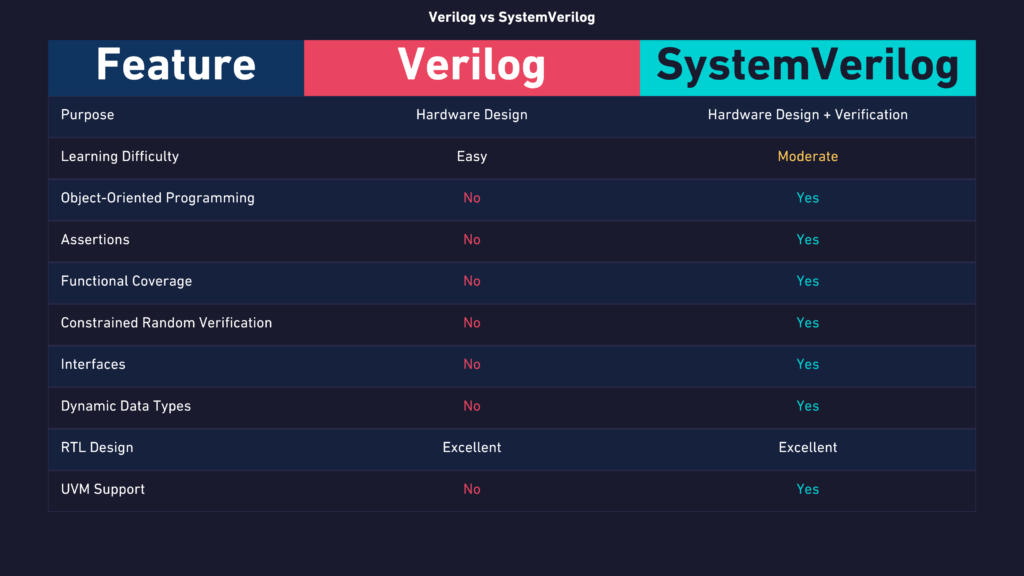
SystemVerilog vs Verilog
Why Was SystemVerilog Introduced?
(SystemVerilog vs Verilog)
As semiconductor chips became increasingly complex, engineers required more powerful methods to verify designs.
Traditional Verilog lacked features such as:
- Advanced testbench development
- Random stimulus generation
- Functional coverage
- Assertion-based verification
- Reusable verification environments
SystemVerilog solved these challenges by integrating powerful verification capabilities into a single standardized language.
Where is Verilog Used?
(SystemVerilog vs Verilog)
Verilog is primarily used in RTL Design.
Common applications include:
- Processor Design
- Finite State Machines
- Arithmetic Units
- Memory Controllers
- Interface Controllers
- FPGA Development
- ASIC RTL Coding
RTL Engineers spend a significant portion of their time writing synthesizable Verilog or synthesizable subsets of SystemVerilog.
Where is SystemVerilog Used?
(SystemVerilog vs Verilog)
SystemVerilog dominates Design Verification.
Typical applications include:
- Testbench Development
- Functional Verification
- UVM Verification
- Assertions
- Random Test Generation
- Coverage Collection
- Regression Testing
Nearly every major semiconductor company relies on SystemVerilog-based verification methodologies for modern chip development.
Can SystemVerilog Replace Verilog?
(SystemVerilog vs Verilog)
Technically, yes.
SystemVerilog is a superset of Verilog.
That means every valid Verilog program is generally valid SystemVerilog.
However, many companies still write synthesizable RTL using coding styles that are compatible with traditional Verilog, while leveraging SystemVerilog features where supported by their toolchains and methodologies.
Which One is Better for RTL Design?
(SystemVerilog vs Verilog)
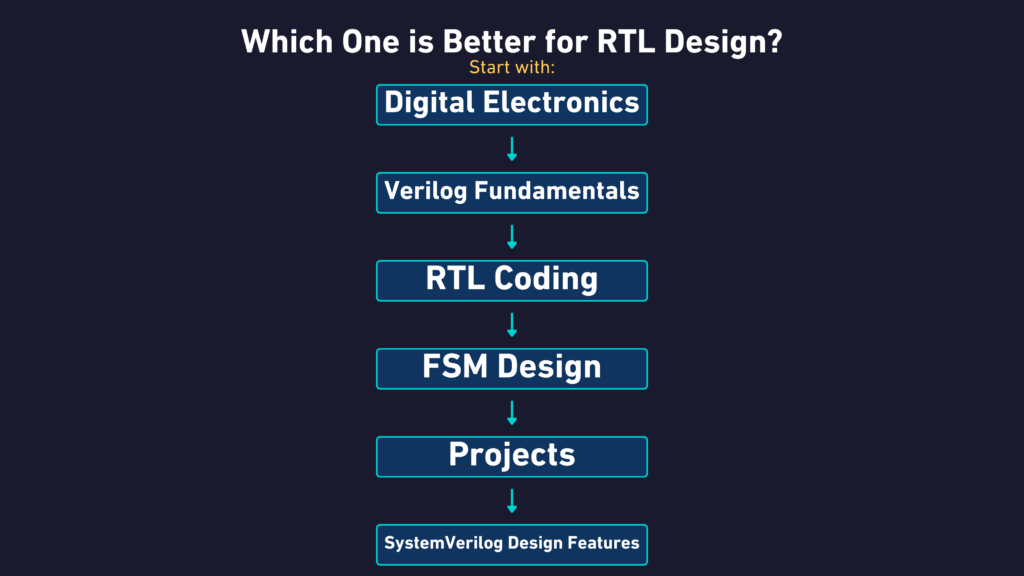
This progression builds strong fundamentals before moving to more advanced language features.
Which One is Better for Design Verification?
If your goal is Design Verification, SystemVerilog is essential.
Modern verification engineers work with:
- Classes
- Randomization
- Assertions
- Functional Coverage
- UVM
- Advanced Testbench Architecture
Without SystemVerilog, learning UVM becomes difficult because UVM is built on SystemVerilog features.
Learning Roadmap
Step 1
Learn Digital Electronics
- Logic Gates
- Flip-Flops
- FSM
- Timing Concepts
Step 2
Master Verilog
- Modules
- Always Blocks
- Case Statements
- FSM Coding
- Testbenches
Step 3
Practice RTL Projects
Examples include:
- UART
- FIFO
- ALU
- Traffic Light Controller
- SPI Controller
Step 4
Learn SystemVerilog
Focus on:
- Interfaces
- Packages
- Assertions
- Classes
- Randomization
Step 5
Choose Your Career
Option 1:
RTL Design Engineer
Option 2:
Design Verification Engineer
Career Opportunities
Verilog Skills
Possible roles:
- RTL Design Engineer
- FPGA Engineer
- ASIC Design Engineer
- Logic Design Engineer
SystemVerilog Skills
Possible roles:
- Design Verification Engineer
- Verification Engineer
- UVM Engineer
- Functional Verification Engineer
Which Language Should You Learn First?
Our recommendation is simple:
If you’re a complete beginner:
Learn Verilog first.
Once you’re comfortable writing synthesizable RTL, transition to SystemVerilog to expand into modern design practices and verification.
This approach provides a strong foundation and aligns with how many engineers naturally progress in the industry.
Frequently Asked Questions (FAQ)
Is SystemVerilog difficult?
Not if you already understand Verilog and Digital Electronics. Most advanced features build upon existing Verilog concepts.
Is Verilog still used?
Yes. Verilog remains widely used for RTL coding, especially in synthesizable hardware design, although SystemVerilog is increasingly adopted as a unified language.
Can I get a VLSI job by learning only Verilog?
You can qualify for entry-level RTL-focused roles, but adding SystemVerilog improves your opportunities and prepares you for verification roles.
Should I learn Verilog or SystemVerilog for FPGA?
Learning Verilog first is generally recommended. After that, SystemVerilog can help you write more maintainable and feature-rich designs, depending on tool support.
Final Thoughts
Verilog and SystemVerilog are not competitors—they complement each other.
Verilog gives you the fundamentals of digital hardware design, while SystemVerilog equips you with advanced capabilities for modern design and verification.
For aspiring VLSI engineers in 2026, the best path is:
Digital Electronics → Verilog → RTL Projects → SystemVerilog → UVM → Job Preparation
Mastering both languages will make you a stronger candidate for roles in RTL Design, FPGA Development, and Design Verification.
External References
- IEEE SystemVerilog Standard: IEEE 1800-2023 Standard
- Accellera SystemVerilog Resources: Accellera Resources
- SystemVerilog Design Tutorial (DVCon): SystemVerilog Design Tutorial