Best Skills for RTL Design Engineers in 2026: Complete Career Roadmap
Introduction
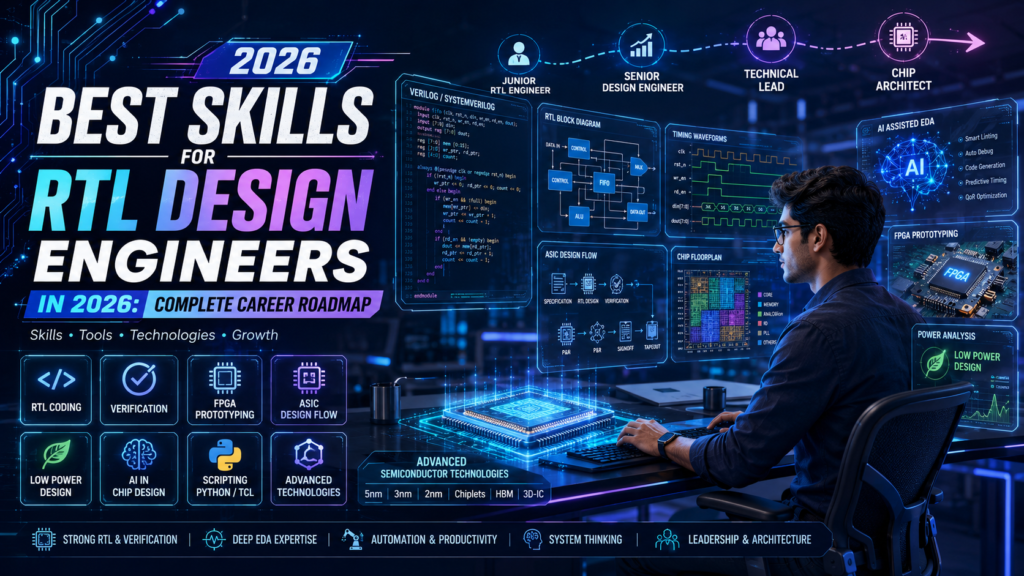
Best Skills for RTL Design Engineers. – VLSI INSIGHTS
RTL (Register Transfer Level) Design remains one of the most sought-after career paths in the semiconductor industry. As modern chips become more complex and AI-driven applications continue to grow, companies are looking for engineers who possess a strong combination of digital design fundamentals, coding expertise, verification knowledge, and system-level understanding.
Whether you are a student, fresher, or experienced engineer looking to advance your career, understanding the skills that employers value most can significantly improve your opportunities in the VLSI industry.
In this article, we explore the most important skills every RTL Design Engineer should master in 2026.
What Does an RTL Design Engineer Do?
RTL Design Engineers are responsible for converting architectural specifications into synthesizable hardware descriptions using languages such as Verilog and System Verilog.
Their responsibilities typically include:
- RTL coding
- Microarchitecture development
- Functional verification support
- Timing-aware design
- Power optimization
- Design reviews and debugging
RTL design serves as the foundation of ASIC and SoC development.
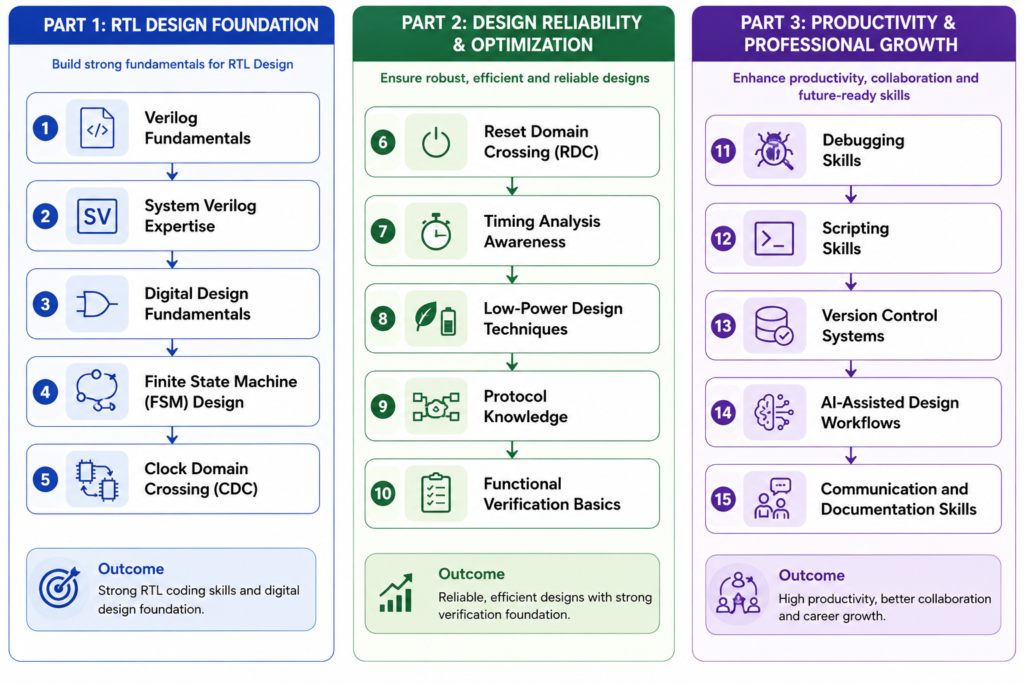
1. Verilog Fundamentals
Verilog remains one of the most important skills for RTL engineers.
Every engineer should understand:
- Modules
- Ports
- Continuous assignments
- Procedural blocks
- Combinational logic
- Sequential logic
- Finite State Machines (FSMs)
Strong Verilog knowledge helps engineers write clean, synthesizable, and reusable RTL code.
Why It Matters
Most semiconductor companies still use Verilog extensively for RTL implementation and maintenance.
2. SystemVerilog Expertise
SystemVerilog has become the industry standard for modern RTL development.
Important concepts include:
- always_comb
- always_ff
- always_latch
- Interfaces
- Packages
- Enumerations
- Structures
- Assertions
SystemVerilog improves code readability, maintainability, and verification integration.
Industry Demand
Most leading semiconductor companies expect RTL engineers to have SystemVerilog experience.
3. Digital Design Fundamentals
A strong RTL engineer must understand digital electronics deeply.
Core concepts include:
- Combinational circuits
- Sequential circuits
- FSM Design
- Counters
- Multiplexers
- Encoders
- Decoders
- Arithmetic Logic Units
Without strong digital design knowledge, writing efficient RTL becomes difficult.
4. Finite State Machine (FSM) Design
FSM design is one of the most frequently tested topics in RTL interviews.
Engineers should know:
- Moore FSM
- Mealy FSM
- State encoding
- State optimization
- One-hot encoding
- Gray encoding
Why FSM Skills Matter
Most digital controllers are implemented using FSMs.
Examples include:
- Protocol controllers
- DMA engines
- Bus interfaces
- Communication modules
5. Clock Domain Crossing (CDC)
Modern SoCs contain multiple clock domains.
RTL engineers must understand:
- Synchronizers
- Metastability
- CDC Violations
- Asynchronous FIFOs
- Handshake Synchronization
CDC issues can cause silicon failures if not handled properly.
6. Reset Domain Crossing (RDC)
RDC has become increasingly important in modern low-power designs.
Engineers should learn:
- Reset synchronization
- Reset sequencing
- Asynchronous reset handling
- RDC verification techniques
Many companies now include RDC checks in sign-off flows.
7. Timing Analysis Awareness
RTL engineers are not STA engineers, but they must understand timing concepts.
Important topics include:
- Setup Time
- Hold Time
- Clock Skew
- Clock Latency
- Critical Paths
Timing-aware coding helps reduce backend challenges later in the design cycle.
8. Low-Power Design Techniques
Power efficiency is a critical requirement in modern chips.
Engineers should understand:
- Clock Gating
- Power Gating
- Multi-Voltage Design
- Retention Registers
- Isolation Cells
Low-power design knowledge is highly valued in mobile, AI, and automotive applications.
9. Protocol Knowledge
Most RTL engineers work on standard communication protocols.
Common protocols include:
- AXI
- AHB
- APB
- PCIe
- USB
- Ethernet
- I2C
- SPI
- UART
Protocol-related questions are common in interviews.
10. Functional Verification Basics
Although RTL and Verification are separate roles, RTL engineers benefit greatly from verification knowledge.
Useful skills include:
- Testbench development
- Assertions
- Functional coverage
- Debugging simulation failures
Understanding verification improves design quality and collaboration.
11. Debugging Skills
Debugging is one of the most valuable skills in semiconductor development.
Engineers should know how to:
- Analyze waveforms
- Trace signal paths
- Identify root causes
- Investigate simulation failures
Strong debugging skills often distinguish excellent engineers from average ones.
12. Scripting Skills
Automation is essential in modern chip development.
Recommended scripting languages:
- Python
- TCL
- Shell Scripting
Automation helps improve productivity and reduce repetitive work.
13. Version Control Systems
Engineers should understand:
- Git
- Branching
- Merging
- Code Reviews
Version control is a standard requirement in professional design teams.
14. AI-Assisted Design Workflows
AI is becoming increasingly important in semiconductor design.
RTL engineers should learn:
- AI-assisted code generation
- Automated debugging
- Design analysis tools
- Prompt engineering for EDA workflows
Engineers who combine RTL expertise with AI knowledge will have a competitive advantage.
15. Communication and Documentation Skills
Technical knowledge alone is not enough.
Successful engineers can:
- Explain design decisions
- Participate in reviews
- Create documentation
- Collaborate effectively
Communication skills become increasingly important as engineers move into senior roles.
Top Skills Ranked by Industry Importance
- SystemVerilog
- Verilog
- Digital Design Fundamentals
- FSM Design
- CDC/RDC Analysis
- Timing Awareness
- Protocol Knowledge
- Debugging Skills
- Verification Basics
- Python/TCL Automation
- Low-Power Design
- AI-Assisted Design Workflows
Future of RTL Design Engineering
in this process of preparing for – Best Skills for RTL Design Engineers, The role of RTL engineers is evolving rapidly. While traditional RTL coding remains essential, future engineers will increasingly leverage AI-powered design tools, automation frameworks, and intelligent verification systems.
The engineers who succeed in 2026 and beyond will combine strong digital design expertise with automation, verification, and AI-driven workflows.
Conclusion
RTL Design Engineering continues to be one of the most rewarding and technically challenging careers in the semiconductor industry. Engineers who master Verilog, SystemVerilog, digital design fundamentals, CDC, timing awareness, and modern automation techniques will remain highly valuable in the years ahead.
Instead of focusing on a single skill, build a balanced foundation across design, verification, debugging, and automation. This approach will significantly improve both your interview performance and long-term career growth.
FAQs
- What skills are required for an RTL Design Engineer?
- Is System Verilog mandatory for RTL Design jobs?
- How important is CDC knowledge in RTL design?
- Do RTL engineers need Python programming?
- Can AI replace RTL Design Engineers?
- Which protocol is most important for RTL interviews?
- What is the salary of an RTL Design Engineer in India?
- How can freshers become RTL Design Engineers?