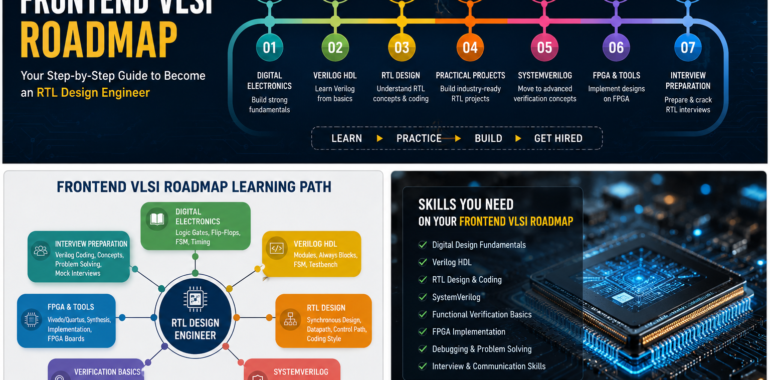
Frontend VLSI Roadmap: Complete Guide to Becoming an Successful RTL Design Engineer in 2026
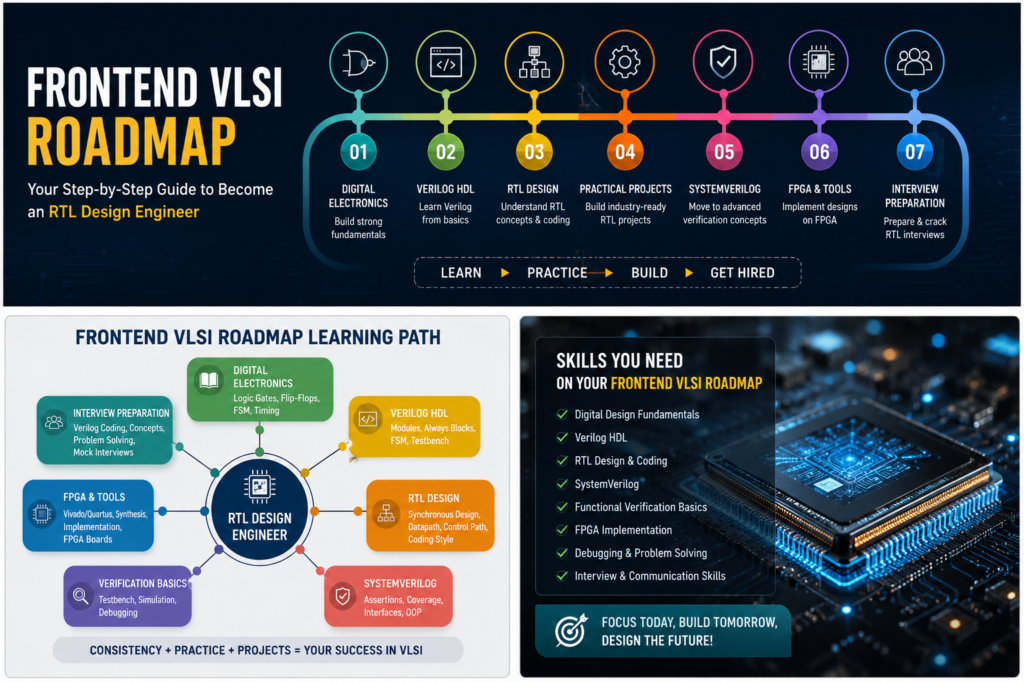
The semiconductor industry is experiencing unprecedented growth, creating exciting opportunities for aspiring engineers. If you are an ECE student, recent graduate, or professional looking to enter the chip design industry, understanding the Frontend VLSI Roadmap is the first step toward building a successful career as an RTL Design Engineer.
What Is the Frontend VLSI Roadmap?
Frontend VLSI focuses on designing and verifying digital circuits before they are physically implemented on silicon. Engineers in this domain work on RTL coding, functional verification, and architecture development using Hardware Description Languages (HDLs) such as Verilog and SystemVerilog.
Popular frontend roles include:
- RTL Design Engineer
- Design Verification Engineer
- FPGA Design Engineer
- SoC Design Engineer
Frontend VLSI Roadmap Step 1: Learn Digital Electronics Fundamentals
Before jumping into RTL coding, you must build a strong foundation in digital electronics.
Key topics include:
- Boolean Algebra
- Logic Gates
- Combinational Circuits
- Sequential Circuits
- Flip-Flops
- Finite State Machines (FSMs)
A strong understanding of these concepts forms the foundation of every successful Frontend VLSI engineer.
Frontend VLSI Roadmap Step 2: Master Verilog HDL
Verilog is the backbone of RTL design. Every aspiring RTL engineer should become comfortable writing synthesizable Verilog code.
Focus on learning:
- Modules and Ports
- Always Blocks
- Case Statements
- Blocking vs Non-Blocking Assignments
- FSM Coding
- Testbench Development
Verilog proficiency is one of the most important milestones in the Frontend VLSI Roadmap.
Frontend VLSI Roadmap Step 3: Build Practical RTL Projects
Projects demonstrate your ability to apply concepts in real-world scenarios.
Recommended projects include:
Frontend VLSI Roadmap Project: Traffic Light Controller
Frontend VLSI Roadmap Project: UART Controller
Frontend VLSI Roadmap Project: FIFO Design
Frontend VLSI Roadmap Project: SPI Controller
These projects help develop RTL coding, debugging, and simulation skills that employers actively seek.
Frontend VLSI Roadmap Step 4: Learn SystemVerilog
Most semiconductor companies expect engineers to have working knowledge of SystemVerilog.
Important topics include:
- Interfaces
- Assertions
- Functional Coverage
- OOP Concepts
Learning SystemVerilog strengthens your position in the Frontend VLSI job market.
Frontend VLSI Roadmap Step 5: Prepare for RTL Design Interviews
Technical interviews typically focus on:
- Digital Electronics
- Verilog Coding
- FSM Design
- Timing Analysis
- Setup and Hold Time
- Debugging Scenarios
Interview preparation is a critical stage of the Frontend VLSI Roadmap.
Frontend VLSI Roadmap Career Opportunities
Engineers with strong RTL design skills are hired by semiconductor companies, product organizations, and technology startups.
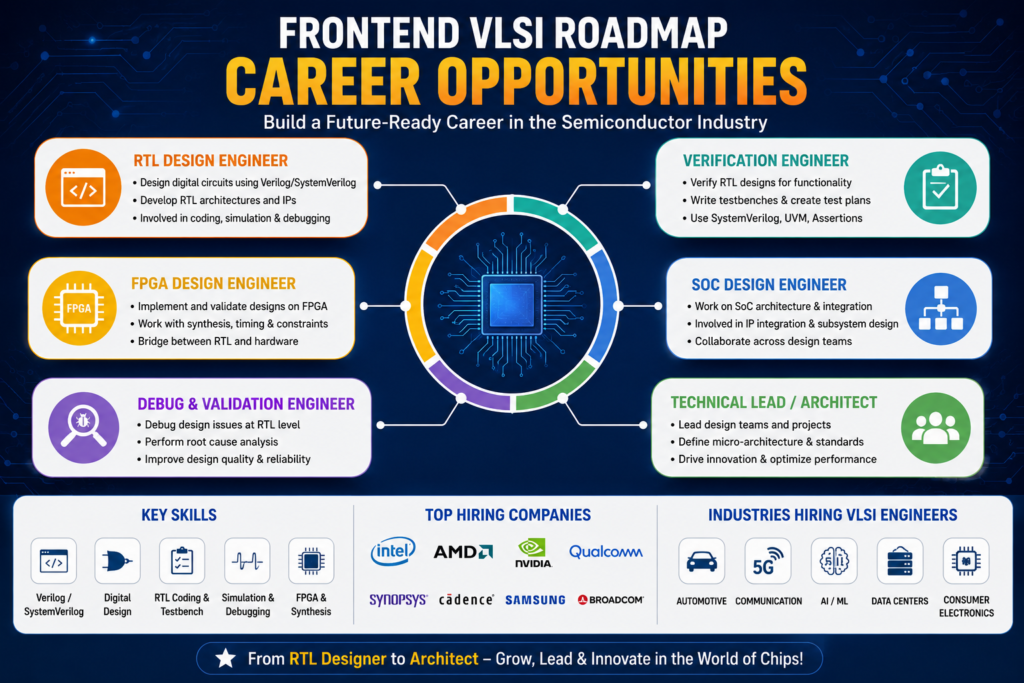
Common career paths include:
- RTL Design Engineer
- Verification Engineer
- FPGA Engineer
- SoC Design Engineer
As experience grows, professionals can advance into architecture and technical leadership positions.
Why Following a Frontend VLSI Roadmap Accelerates Your Career
A structured learning path helps avoid common mistakes and ensures that you develop the skills employers demand. By mastering digital design, Verilog, SystemVerilog, RTL projects, and interview preparation, you can significantly improve your chances of landing your first VLSI role.
Conclusion: Start Your Frontend VLSI Roadmap Today
Following a structured Frontend VLSI Roadmap is one of the fastest ways to become job-ready in the semiconductor industry. With the right combination of technical knowledge, hands-on projects, and interview preparation, you can build a rewarding career as an RTL Design Engineer.
Ready to Accelerate Your Frontend VLSI Roadmap?
Join the VLSI Insights Frontend VLSI Program for expert mentorship, industry-level projects, interview preparation, and career guidance designed to help you become an RTL Design Engineer.
Frequently Asked Questions (FAQs)
1. What is the Frontend VLSI Roadmap for beginners?
The Frontend VLSI Roadmap typically starts with Digital Electronics, followed by Verilog HDL, RTL Design, SystemVerilog, FPGA projects, and interview preparation. Following a structured roadmap helps students become job-ready RTL Design Engineers.
2. How long does it take to complete the Frontend VLSI Roadmap?
For most beginners, it takes around 6–12 months to become job-ready, depending on their learning pace, project experience, and interview preparation.
3. What skills are required to become an RTL Design Engineer?
The most important skills include:
- Digital Electronics
- Verilog HDL
- RTL Design
- FSM Design
- SystemVerilog
- Debugging and Simulation
- Timing Concepts
- Problem-Solving Skills
4. Is Verilog enough to get an RTL Design job?
Verilog is the foundation of RTL Design, but many companies also expect candidates to understand SystemVerilog, RTL verification basics, and industry-standard design practices.
5. Should I learn Verilog or SystemVerilog first?
You should start with Verilog because it forms the foundation of RTL Design. Once you are comfortable with Verilog, you can move on to SystemVerilog for advanced design and verification concepts.
6. Are FPGA projects important in the Frontend VLSI Roadmap?
Yes. FPGA projects help demonstrate practical implementation skills and strengthen your resume. Recruiters often prefer candidates who have worked on real-world projects such as UART, FIFO, SPI, or RISC-V processor designs.
7. What are the best projects for Frontend VLSI beginners?
Some of the best beginner-friendly projects include:
- Traffic Light Controller
- UART Controller
- FIFO Design
- SPI Controller
- PWM Generator
- Digital Clock
These projects help develop RTL coding, simulation, and debugging skills.
8. What is the average salary of an RTL Design Engineer in India?
The salary depends on experience and company type:
- Freshers: ₹5–12 LPA
- 2–5 Years: ₹12–25 LPA
- 5+ Years: ₹25–50+ LPA
Professionals with strong RTL Design and SystemVerilog skills often receive higher compensation packages.
9. What interview topics are commonly asked for RTL Design roles?
Recruiters frequently ask questions on:
- Digital Electronics
- FSM Design
- Verilog Coding
- Blocking vs Non-Blocking Assignments
- Setup and Hold Time
- Clock Domain Crossing (CDC)
- RTL Debugging
10. Is Frontend VLSI a good career in 2026?
Yes. The demand for Frontend VLSI engineers continues to grow due to advancements in AI, automotive electronics, 5G communication, data centers, and semiconductor manufacturing. RTL Design and Verification remain among the most sought-after skills in the industry.
11. Can ECE students start learning Frontend VLSI during college?
Absolutely. In fact, starting during college gives students an advantage because they can build projects, gain practical experience, and prepare for interviews before graduation.
12. What is the best way to learn Frontend VLSI?
The most effective approach is to combine:
- Strong digital design fundamentals
- Hands-on Verilog coding
- Industry-level RTL projects
- SystemVerilog training
- Interview preparation
A structured training program with mentorship can significantly accelerate the learning process and improve job placement opportunities.
13. Which is the best Frontend VLSI course for freshers?
The best Frontend VLSI course should include Digital Electronics, Verilog, RTL Design, SystemVerilog, project-based learning, interview preparation, and placement assistance. Look for programs that provide hands-on industry projects and expert mentorship to help you become job-ready faster.
OTHER BLOGS
Vlsi Insights
Blogs for you